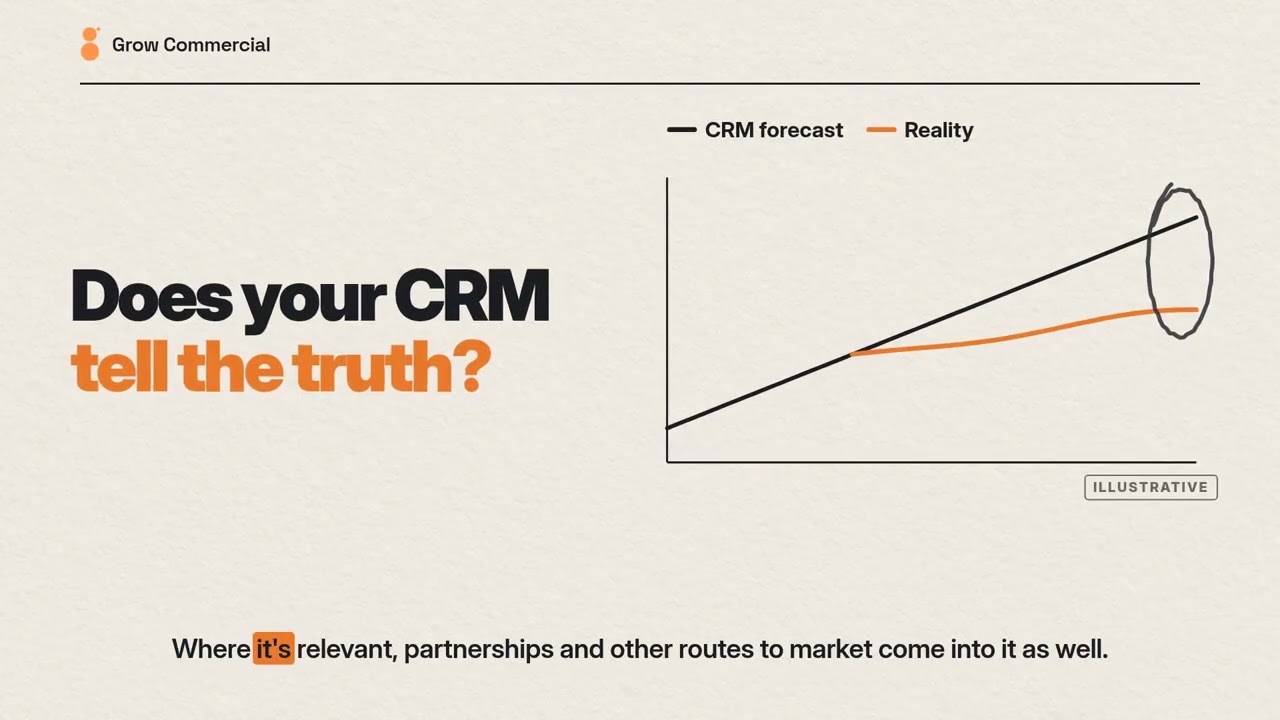
Does your CRM tell the truth?
Often it doesn't, and every forecast built on it inherits the error. That flows into decisions about hiring, spend and targets. CRMs rarely drift on purpose. Deals get added after a good first call and never updated, stages move forward because a proposal went out, and close dates slide a month at a time. A ten-minute check fixes most of it. Go through every open deal and look for three things: a named owner, a next step the buyer has agreed to with a date on it, and a stage the buyer would recognise if you described it to them. A deal that fails any of those is a hope, not an opportunity. Then look at close dates. If one has moved more than once, ask the buyer directly: either there is a new date they have agreed, or the deal comes out of the forecast. The fix is usually a habit rather than a new tool, so define stages by what the buyer has done and run the check every week.
- 0:00Forecasts start in the CRM
- 0:13How it drifts
- 0:34The ten-minute check
- 0:58Hope or opportunity?
- 1:14The close date test
- 1:32A habit, not a tool
- 1:55The truth first
Read the full transcript
Every forecast you make starts in your CRM. If the CRM doesn't reflect what's really happening, every number built on it starts from the wrong place.
It rarely goes wrong on purpose. Deals get added after a good first call and never updated. Stages get moved forward because a proposal went out. Close dates slide a month at a time, and nobody removes the deal in case it still comes in.
Here's a check that takes about ten minutes. Go through your open deals one at a time. Each deal needs a named owner, so someone is responsible for it. It needs a next step the buyer has agreed to, with a date on it. And it needs to sit at a stage the buyer would recognise if you described it to them.
Count how many deals pass all three. The ones that fail aren't necessarily dead, but they aren't telling the truth either. A deal with no agreed next step is a hope, not an opportunity.
Then check close dates. Any deal whose date has already moved more than once deserves a direct question to the buyer. Either there's a new date they've agreed, or the deal comes out of the forecast until there is.
The fix usually isn't a new tool. It's a habit. Agree what each stage means in terms of what the buyer has done. Check every open deal against those three things each week, and let stale deals go. The pipeline may look smaller. What's really shrinking is the guesswork.
A CRM that tells the truth is the first thing a good forecast needs.
Want to talk this through for your business?
Related: The GTM diagnostic
Want to see how this works in your business?
Book a free 30-minute GTM call with the Grow team. We'll talk through where your commercial engine is getting stuck and what to look at first.
More videos